The Big Screen Bites Back: Why Going to the Movies Feels Radical Again
Something happened in the summer of 2023 that the entertainment industry is still quietly processing. Two movies — one a neon-pink toy franchise film, one a three-hour theoretical physics biopic — turned going to the movies into a national event. People wore costumes. They made plans weeks in advance. They went twice, three times. They argued about the films with strangers online and friends in parking lots. The theatrical experience, which had been declared functionally dead by pandemic-era conventional wisdom, revealed itself to be not just alive but hungry.
Barbenheimer wasn't a fluke. It was a signal.
What Streaming Accidentally Broke
To understand why theaters are reasserting themselves, you have to understand what the streaming revolution actually did to the experience of watching things. It gave us abundance and took away occasion.
When a film drops on a streaming platform, it arrives without ceremony. It's just... there, added to a library of thousands of other things, competing with your backlog, your rewatch comfort picks, and the seventeen other tabs you have open. There's no countdown, no shared opening weekend, no collective first encounter. You watch it when you get around to it, which might be never, which is fine, because it's not going anywhere, which somehow makes it less urgent, which makes it easier to defer, which is how a critically acclaimed film can be available to 200 million subscribers and feel culturally invisible.
Streaming optimized for access and accidentally destroyed anticipation. And it turns out anticipation was doing a lot of the work.
The Psychology of Shared Time
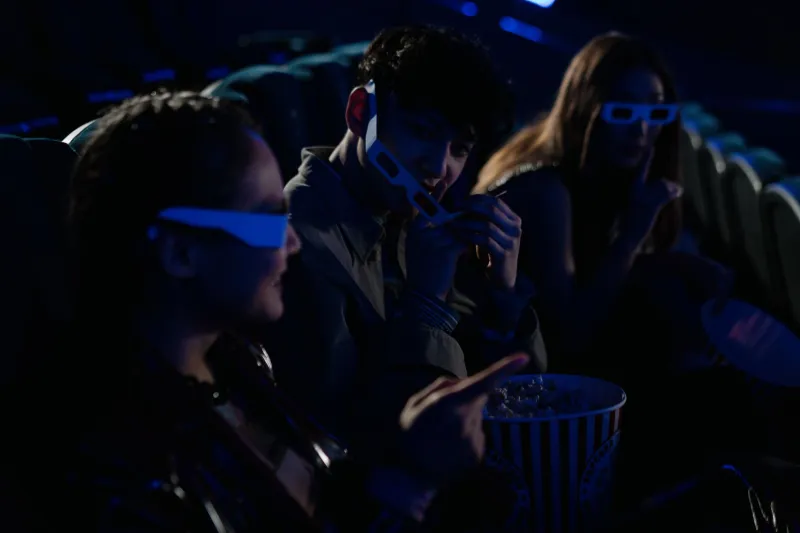
Here's what the theater offers that no home setup can replicate: you are watching the same thing, at the same moment, as a room full of strangers who chose to be there. That's it. That's the whole magic trick, and it's more powerful than it sounds.
Humans are social creatures who calibrate emotional responses partly through other people. Laughter is contagious — not metaphorically, neurologically. Fear is more intense when it's shared. Grief lands differently in a room full of people quietly crying than it does alone on your couch. The audience isn't just background noise; it's part of the sensory experience of the film itself. A joke that kills in a packed Friday night screening lands differently in an empty Tuesday afternoon theater, and both of those are different from watching on your laptop.
This is what film theorists have called the "apparatus" of cinema — the whole context of projection, darkness, scale, and communal presence that shapes how we receive moving images. Streaming stripped away the apparatus and kept the content. For a while, that seemed like a reasonable trade. Now the appetite for the full experience is making itself known.
Events vs. Content
The industry distinction that's emerging is between content and events, and it maps pretty cleanly onto the streaming-versus-theatrical divide.
Content is what you consume. It fills time, it entertains, it might be excellent — but it exists in a flow. You finish one thing and another begins. Netflix's autoplay feature is a literal manifestation of this: the next thing starts before you've fully processed the last thing. Content is designed to keep you in the stream.
Events are what you attend. They have a before and an after. They require something of you — a decision, a commute, the act of showing up. And they exist in shared time with other people, which means your experience of them is social in a way that solo streaming fundamentally isn't.
The films that are driving theatrical resurgence are almost exclusively events. Top Gun: Maverick. Everything Everywhere All at Once. The entire Marvel theatrical run at its peak. Oppenheimer. Dune: Part Two. These aren't just movies people wanted to see — they're movies people wanted to have seen, to have been present for, to be able to talk about from the position of someone who was in the room where it happened.
What Streaming Missed About Human Nature
The streaming era was built on a particular model of the viewer: a sovereign individual who wants maximum choice, minimum friction, and total control over their entertainment experience. In many ways, that model was accurate. People do want those things.
But it missed something. People also want to be part of something larger than their own living room. They want the shared reference, the opening-weekend conversation, the sense that culture is happening in real time and they're inside it rather than catching up to it later. The algorithmic personalization that streaming uses to serve you content optimized for your taste also, quietly, isolates you from the common cultural experience. When everyone's watching something different, there's nothing to talk about at the water cooler — or whatever the 2024 equivalent is.
The theatrical model, for all its inconveniences, forces a kind of cultural synchrony. Opening weekends create moments. And moments, it turns out, are what people remember — not the 47th thing they watched on a platform in a year of continuous consumption.
The Theater Has to Earn It Back
None of this means the theater industry gets to coast on nostalgia. The resurgence is real, but it's selective. People are going to the movies for events — they're not going back to the weekly moviegoing habit of previous generations. The films that are thriving theatrically are the ones that justify the trip: visually spectacular, emotionally communal, designed at a scale that makes the big screen feel necessary rather than optional.
Mid-budget adult dramas — the kind of films that built the prestige era of the '90s and early 2000s — still struggle to find theatrical footing because they don't offer a sufficiently compelling reason to leave the house. That's a real creative loss, and it's one of the genuine casualties of the streaming shift. Not everything can be an event, and the theatrical model increasingly demands that everything it houses be one.
But here's the thing: the demand for shared cultural experience is clearly still there. Barbenheimer proved it. Taylor Swift's concert film proved it. The collective hunger to be in a room together, experiencing something simultaneously, having something to argue about and quote and reference — that's not going away.
The big screen didn't lose to streaming. It just had to wait for people to remember what they were missing.